연구진은 수정 항체를 만들어 암에서 RAS와 p53을 표적으로 삼는다
2021.04.14 · amschool
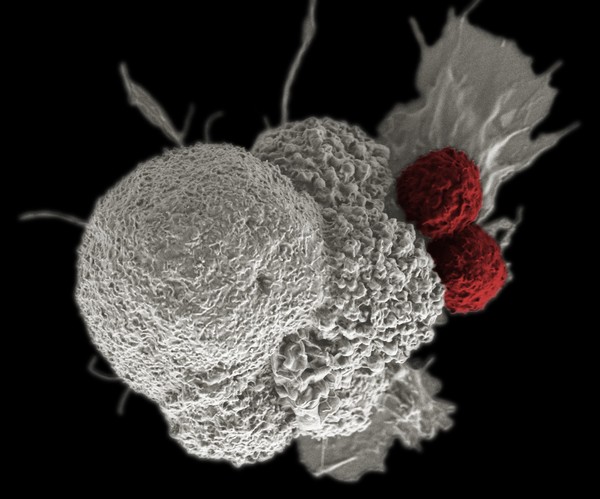
연구원들은 암과 관련된 가장 악명 높은 두 가지 단백질인 RAS와 p53을 표적으로 삼는 영리한 방법을 생각해냈다. 일련의 연구에서 과학자들은 쥐에게 돌연변이 단백질을 숨겨주고 있는 종양을 수축시키는 합성 항체를 고안했다.
존스 홉킨스 의대 연구진이 이끄는 연구팀은 혈액 암 세포에 단백질을 표적으로 하는 항체를 설계하는 데도 비슷한 방법을 사용했다.
새로 설계된 항체는 다리처럼 작용해 한쪽 끝은 면역세포, 다른 쪽 끝은 암세포를 붙잡는다. 항체들은 그들을 가까이 끌어당김으로써 면역 세포들이 암세포를 찾아 죽이도록 돕는다. 이 접근법을 설명하는 세 가지 연구가 3월 1일 다른 저널에 발표되었다.
종양의 성장을 촉진하는 TP53과 RAS 유전자의 돌연변이는 암에서 매우 흔하며, 각각 전체 종양의 약 50%와 30%에서 발견된다. 그러나 이러한 변이된 유전자에 의해 만들어진 단백질은 암 약물을 만드는 일반적인 방법으로는 잘 적중하지 않기 때문에, 연구원들은 전통적인 경로를 덜 탐구해 왔다. 과학자들이 최근 KRAS의 한 돌연변이 형태에 대항하여 전진을 하고 있지만, 그들은 돌연변이 p53을 표적으로 삼는 행운을 얻지 못했다.
RAS와 p53은 고부가가치 표적이라고 연구 리더인 홉킨스의 시빈 저우 박사는 "사람들은 수년 동안 이러한 표적들을 추적해 왔다"고 말했다.
P53 단백질의 돌연변이 형태를 표적으로 삼는 것은 특히 어려운 일이다. 왜냐하면 그것들은 일반적으로 활동적이지 않은 단백질이고, 대부분의 암 약물은 과잉 활성 단백질을 차단함으로써 작용하기 때문이다. 세포의 성장을 조절하고 돌연변이를 일으킬 때 활동하지 않는 TP53과 같은 유전자를 종양 억제 유전자라고 부른다.
홉킨스의 연구원인 산드라 가벨리 박사는 "비활성 단백질의 활동을 회복하는 것이 너무 어렵기 때문에 종양 억제제를 표적으로 할 수 있었다는 것은 큰 일"이라고 말했다.
새롭게 설계된 항체는 돌연변이 단백질의 활동을 차단하거나 복원하기보다는 돌연변이 단백질 조각을 과녁의 중심으로 사용해 면역세포가 암세포를 찾아 공격하기 쉽다.
연구 저자들은 "이 접근 방식은 기존의 방법으로 표적 삼기 어려운 다른 일반적인 [암 관련] 돌연변이에 적용될 수 있어 보다 구체적인 항암 치료법이 가능하다"고 썼다.
드문 신 항원의 검색
실험실에서 만든 항체는 여러 가지 암 치료법의 기초이다. 이것들은 상당히 비슷한 단백질을 구분할 수 있으며 세포 기반 면역요법보다 훨씬 더 쉽고 덜 비싸다.
그러나 단점은 항체는 세포 안에 들어가기엔 일반적으로 너무 크다는 것이고, 암의 성장을 이끄는 많은 단백질을 포함한 대부분의 단백질은 세포 안에 있다는 것이다. 하지만 허점이 있다. 건강한 세포와 암세포 모두 표면에 HLA라고 알려진 수용체에 의해 둘러싸인 내부 단백질의 조각들을 드러내 보인다.
암세포 표면은 또한 신 항원으로 알려진 돌연변이 단백질의 파편을 보여준다. 이러한 동일한 단백질 조각은 건강한 세포에서 발견되지 않기 때문에, 신 항생물을 대상으로 하는 약물은 건강한 세포를 해칠 가능성이 적을 수 있다.
하지만 항체가 있는 신 항원을 표적으로 삼는 것은 어려운 일이다. 왜냐하면 신 항원은 드문 경향이 있기 때문이다. 홉킨스 연구팀은 암세포 표면에는 돌연변이 단백질의 신 항원이 10개 미만이라고 밝혔다. 대부분의 항체 기반 치료법은 암세포를 찾아내 죽이기 위해 수백 또는 수천 개의 표적을 필요로 한다고 홉킨스 팀은 지적했다.
지금까지, 그것은 암에 대한 신 항원 유도 항체 치료법을 개발하는 데 주요한 한계였다. 팀이 설계한 항체는 이러한 희박한 표적을 검색하고 연결할 수 있는 것으로 보인다.
이 연구들은 "암 세포의 표면에 있는 저밀도 항원을 표적으로 할 수 있고 건강한 세포를 죽이지 않을 수 있다는 개념의 증거"라고 말했다.
p53과 RAS를 추적가기
인체에 의해 만들어진 항체는 같은 표적에 결합하는 두 개의 "팔"을 가진 Y자 모양의 단백질이다. 하지만 연구원들은 창의적이고 공학적인 "2중 특정" 항체를 얻었는데, 이 항체는 각각의 팔로 서로 다른 표적과 결합된다.
2중 특이 항체는 서로 다른 배열형태로 나온다. 홉킨스 팀은 여섯 가지 다른 유형을 테스트했고 단일 체인(단쇄) 이중체 형식이 일관되게 가장 잘 작동한다는 것을 발견했다. 구조 생물학자인 가벨리 박사는 "단일 연쇄 이중체는 서로 다른 두 개의 항체가 서로 융합된 것처럼 보인다"고 설명했다.
그녀는 "이 단일 연쇄 이중체는 일반 항체보다 작고, 더 치밀하고, 더 둥근 단백질"이라고 덧붙였다.
연구팀은 가장 일반적인 TP53과 RAS 돌연변이의 단백질 파편을 한쪽 끝으로 잡고 다른 쪽 끝은 면역 세포를 잡는 단일 사슬 이중체를 만들었다. 실험실 실험에서, p53과 RAS 특이의 이중체는 각각의 신 항원 표적에 부착되었지만, 정상 p53과 RAS 단백질이나 다른 밀접하게 관련된 단백질들의 파편에는 부착되지 않았다.
의도한 표적이 아닌 다른 표적에 결합하는 약물은 심각한 부작용을 일으킬 수 있다고 연구원들은 지적했다.
실험용 접시에서 단일 연쇄 이중체는 난소암과 췌장암, 백혈병 등 TP53 또는 RAS 돌연변이를 가진 여러 종류의 암세포를 죽이도록 면역세포에 지시하였다.
쥐의 경우 p53의 이중체로 치료하면 p53의 파편에 결합되지 않는 빈 이중체에 비해 TP53 돌연변이 종양이 줄어들었다. 그리고 RAS 돌연변이 종양을 가진 생쥐의 경우 RAS 특이의 이중체로 치료하면 종양 성장이 다소 느려진다.
혈액 암용 이중체
일부 혈액 암은 B세포나 T세포라고 불리는 면역세포가 암으로 변할 때 시작된다.
항체 기반 치료법은 B세포 암을 치료하는 방법을 획기적으로 변화시켰다. 예를 들어, B세포 급성 림프아구성 백혈병에 효과적인 치료제인 이중 특이 항체 블리나투모맙(상표명 ; 불린사이토)가 있다. 모든 B세포가 발현하는 단백질에 결합하는 블리나투모맙과 같은 면역요법은 암세포와 건강한 B세포를 모두 죽일 수 있다. 다행히도, 환자들은 건강한 B세포를 잃는 것을 견딜 수 있다.
반면에, 건강한 T 세포와 암성의 T 세포 모두를 강타하는 약물은 그 사람의 면역 체계를 심각하게 손상시킬 것이라고 폴 박사는 설명했다. 그래서 T세포 암에 대한 항체 치료법은 거의 없다. 왜냐하면 건강한 T세포가 아닌 암성의 T세포에 존재하는 분자를 찾는 것이 어려웠기 때문이다.
이 점을 염두에 둔 홉킨스 팀은 T세포 수용체(TCR)에 초점을 맞추었다. 정상 또는 암세포인 각 T세포는 30개의 T세포 수용체 가변 부위 유전자군 중 1개를 발현한다. 이 유전자들은 건강한 T 세포에 의해 다소 무작위로 발현된다. 그러나 T세포 암을 가진 사람의 경우, 모든 암세포가 동일한 T세포 수용체 가변 유전자를 발현하는데, 이는 그들이 모두 동일한 T세포 수용체(TCR)를 가지고 있다는 것을 의미한다.
그래서 개념의 증명으로서, 연구원들은 두 개의 T세포 수용체 가변 유전자를 표적으로 하는 단일 연쇄 이중체를 만들었다. 실험실에서 실험한 결과, 이중체는 건강한 T세포가 일치하는 T세포 수용체 가변성 유전자를 가진 암성 T세포를 구체적으로 죽이도록 자극했다.
백혈병 T세포와 건강한 인간 T세포를 이식한 쥐에서, 두 개의 이중체 중 하나를 사용하여 치료하면 쥐의 암 발병이 급격하게 줄어들었다. 또한 백혈병 특이 이중체로 치료받은 쥐는 관련 없는 암을 표적으로 한 이중체로 치료받은 쥐보다 수명이 더 길었다. 중요한 것은, 그 치료는 작동하는 면역 체계를 보존하기 위해 충분한 수의 건강한 T세포를 남겨두었다는 것이다.
암 치료제로서의 잠재력
새로 디자인된 당뇨병은 아직 인체 연구에서 시험할 준비가 되지 않았다. 하지만 연구팀은 그들의 잠재력에 대해 희망적이다.
알링턴 텍사스 대학의 Jon Weidanz 박사는 이 세 가지 연구에 대한 논평에서 이러한 당뇨병을 암 치료로 사용하는 것에 대한 몇 가지 고려 사항을 언급했다.
하나는 당뇨병을 이용한 치료법이 기성면역요법이 될 수 있다는 것인데, 이것이 큰 장점이 될 것이다. 이러한 치료는 대량으로 제조되어 쉽게 구할 수 있는 치료로 저장될 수 있는 반면, CART-세포 치료는 각 환자마다 맞춤 제작되어야 한다.
그러나 연구팀은 환자들이 특정 당뇨병에 대해 일치하는 돌연변이와 HLA 유형, 또는 TCR 변수 유전자와 일치해야 하기 때문에 여전히 당뇨병에 약간 적응해야 한다고 지적했다. 비록 어떤 형태는 다른 형태보다 더 흔하지만, 다른 사람들은 다른 형태의 HLA를 가질 수 있다.
홉킨스 팀은 가장 흔한 변이암 단백질과 HLA를 위한 당뇨병을 만들고 싶어한다. 가벨리 박사는 "이는 전 세계적으로 매년 약 1백만 명의 환자에게 적용될 것"이라고 말했다.
웨이단즈 박사는 '이러한 당뇨병이 환자에게 어떻게 주어지는지도 또 다른 고려사항'이라고 썼다. Bispecific 항체는 작기 때문에 몇 분에서 몇 시간 안에 혈액에서 걸러진다고 Paul 박사는 설명했다. 쥐를 치료하기 위해, 연구원들은 지속적으로 당뇨병을 방출하는 작은 펌프를 사용했다.
B세포 백혈병의 이원 항체 치료제인 블리나타모맵도 같은 방식으로 환자에게 전달된다. 그리고 그것은 클리닉에서 놀라운 성공을 보여주고 있다. 이것은 우리의 분자들이 클리닉으로 잘 번역될 것이라는 희망을 갖게 한다.
생체표지 검사를 받은 환자들은 종종 자신의 암에 TP53 돌연변이가 있다는 것을 발견하고 그것을 목표로 하는 가능한 약물에 대해 물어본다고 폴 박사는 말했다. 그는 "이러한 기술로, 우리는 단지 시험 보고서를 응시하는 대신 개입하여 유용한 치료를 제공할 수 있을 것"이라고 말했다.
TP53은 1989년 이 연구의 수석 저자인 Bert Vogelstein에 의해 종양 억제 유전자로 확인되었다. 마침내 단백질을 목표물로 삼는 방법을 갖는 것은 그에게 '평생 꿈'이라고 저우 박사는 말했다.
저우 박사는 "이는 암 유전학, 면역학, 구조 생물학, 그리고 의학 종양학 전문가들 사이의 진정한 학문 간 노력이었다. 우리가 모두 모이면 좋은 일이 일어납니다"라고 덧붙였다.
Researchers Create Modified Antibodies to Target RAS and p53 in Cancer
April 2, 2021, by NCI Staff
Researchers have come up with a clever way to target two of the most notorious proteins involved in cancer, RAS and p53. In a series of studies, the scientists designed synthetic antibodies that, in mice, shrank tumors harboring these mutant proteins.
The team, led by researchers from the Johns Hopkins University School of Medicine, also used a similar approach to design antibodies that target a protein on blood cancer cells.
The newly designed antibodies act like a bridge, grabbing onto immune cells with one end and cancer cells with the other. By pulling them close together, the antibodies help immune cells find and kill the cancer cells. Three studies describing the approach were published on March 1 in different journals.
Mutations in the TP53 and RAS genes that promote tumor growth are quite common in cancer, being found in around 50% and 30% of all tumors, respectively. But the proteins made by these mutated genes have been hard to hit with the usual approaches to creating cancer drugs, so researchers have been exploring less conventional avenues. Although scientists have recently made headway against one mutant form of KRAS, they haven’t had any luck targeting mutant p53.
RAS and p53 “are high-value targets,” said study leader Shibin Zhou, Ph.D., of Hopkins. “People have been going after these targets for many years.”
It’s especially challenging to target mutant forms of p53 because they are generally inactive proteins, and most cancer drugs work by shutting off overactive proteins. Genes like TP53 that control cell growth and become inactive when mutated are called tumor suppressor genes.
“It’s a big deal that we were able to target a tumor suppressor because it’s so difficult to restore the activity of an inactive protein,” said study investigator Sandra Gabelli, Ph.D., of Hopkins.
Rather than blocking or restoring the activity of the mutant proteins, the newly designed antibodies use pieces of the mutant proteins as bullseyes, making it easier for immune cells to find and attack cancer cells.
“This approach could be applied to other common [cancer-related] mutations that are difficult to target by conventional means, allowing for more specific anticancer therapeutics,” the study authors wrote.
Searching Out Sparse Neoantigens
Lab-made antibodies are the basis of many different cancer treatments. They can distinguish between proteins that are remarkably similar and they’re easier and less expensive to make than cell-based immunotherapies.
However, a downside is that antibodies are typically too large to get inside cells, and most proteins—including many that drive cancer growth—are located inside the cell. But there is a loophole: Both healthy and cancer cells display snippets of inside proteins on their surfaces, cradled by a sort of receptacle known as HLA.
Cancer cell surfaces also display fragments of mutated proteins, known as neoantigens. Because these same protein snippets aren’t found on healthy cells, drugs targeting neoantigens may be less likely to harm healthy cells.
But it’s challenging to target neoantigens with antibodies because they tend to be scarce: There are less than 10 neoantigens from a mutant protein on the surface of a cancer cell, the Hopkins team found. Most antibody-based therapies require hundreds or thousands of targets to find and kill a cancer cell, they noted.
Until now, that was a major limitation to developing neoantigen-directed antibody treatments for cancer, Dr. Gabelli said. The antibodies the team designed appear to be able to search out and link to these sparse targets.
These studies are “proofs of concept that … we can target a low-density antigen on the surface of cancer cells and not kill healthy cells,” said Suman Paul, M.B.B.S., Ph.D., a medical oncology fellow at Hopkins.
Going After p53 and RAS
Antibodies made by the human body are Y-shaped proteins with two “arms” that bind to the same target. But researchers have gotten creative, engineering "bispecific" antibodies that bind to a different target with each arm.
Bispecific antibodies come in different configurations. The Hopkins team tested six different types and found that the “single-chain diabody” format consistently worked best. Single-chain diabodies look like the tips of two different antibodies fused together end-to-end, explained Dr. Gabelli, a structural biologist.
It “is a smaller, more compact, and more globular protein than [a regular] antibody,” she added.
The team created single-chain diabodies that grab onto protein fragments of the most common TP53 and RAS mutations with one end and immune cells with the other. In lab experiments, the p53- and RAS-specific diabodies attached to their respective neoantigen targets but not to fragments from normal p53 and RAS proteins or from other, closely related proteins.
Drugs that bind to something other than the intended target can cause serious side effects, the researchers noted.
In lab dishes, the single-chain diabodies directed immune cells to kill several different kinds of cancer cells harboring either a TP53 or RAS mutation, including ovarian cancer, pancreatic cancer, and leukemia.
In mice, treatment with the p53-specific diabody shrank TP53-mutant tumors compared with a “blank” diabody that doesn’t bind to p53 fragments. And in mice with RAS-mutant tumors, treatment with RAS-specific diabodies modestly slowed tumor growth.
A Diabody for Blood Cancers
Some blood cancers start when immune cells called B cells or T cells turn cancerous.
Antibody-based therapies have drastically changed how B-cell cancers are treated, Dr. Paul said. For example, the bispecific antibody blinatumomab (Blincyto) is an effective treatment for B-cell acute lymphoblastic leukemia. Immunotherapies like blinatumomab, which bind to proteins expressed by all B cells, can kill both cancerous and healthy B cells. Fortunately, patients can withstand losing healthy B cells.
On the other hand, drugs that hit both healthy and cancerous T cells would severely damage the person’s immune system, Dr. Paul explained. So, there are few antibody therapies for T-cell cancers (such as T-cell acute lymphoblastic leukemia or T-cell lymphoma) because it’s been challenging to find molecules that are present on cancerous T cells but not healthy T cells.
With that in mind, the Hopkins team zeroed in on the T-cell receptor (TCR). Each T cell, normal or cancerous, expresses 1 of 30 TCR variable region gene families. These genes are more or less randomly expressed by healthy T cells. But for an individual with T-cell cancer, all of their cancerous T cells express the same TCR variable gene, meaning they all have an identical TCR.
So, as a proof of concept, the researchers created single-chain diabodies that target two TCR variable genes. Testing in the lab showed that the diabodies prompted healthy T cells to specifically kill cancerous T cells with the matching TCR variable gene.
In mice implanted with leukemic T cells and healthy human T cells, treatment with either of the two diabodies drastically lowered the amount of cancer in the mice. In addition, mice treated with the leukemia-specific diabody lived longer than mice treated with a diabody targeting an unrelated cancer. Importantly, the treatment spared enough healthy T cells to preserve a functioning immune system.
Potential as Cancer Treatments
The newly designed diabodies are not yet ready to be tested in human studies. But the research team is hopeful about their potential.
In a commentary on the three studies, Jon Weidanz, Ph.D., of the University of Texas at Arlington, noted several considerations for using these diabodies as cancer treatments.
One is that a diabody-based treatment could be an off-the-shelf immunotherapy, which would be a major advantage. Such treatments could be manufactured in bulk and stored as a readily available treatment, whereas CAR T-cell therapy must be tailor-made for each patient.
But the diabodies would still have to be tailored slightly, the research team noted, because patients would need to have the matching mutation and HLA type, or matching TCR variable gene, for a particular diabody. Different people can have different forms of HLA, although some forms are more common than others.
The Hopkins team hopes to create diabodies for the ten most common mutated cancer proteins and HLAs. “That would apply to about 1 million patients per year, worldwide.” Dr. Gabelli noted.
How such diabodies would be given to patients is another consideration, Dr. Weidanz wrote. Bispecific antibodies are small, so they are filtered out of the blood within minutes to hours, Dr. Paul explained. To treat mice, the researchers used a small pump that continuously releases the diabodies.
Blinatumomab, the bispecific antibody treatment for B-cell leukemia, is delivered to patients the same way. And it’s “showing remarkable success in the clinic. That makes us hopeful that our molecules will translate well into the clinic as well,” Dr. Paul said.
Patients who get biomarker testing often find out that they have a TP53 mutation in their cancer and ask about possible drugs to target it, Dr. Paul said. “With these techniques, we may be able to intervene and offer a useful treatment instead of just staring at the [testing] report,” he said.
TP53 was identified as a tumor suppressor gene in 1989 by Bert Vogelstein, M.D., a senior author of the studies, and others. Having a way to finally target the protein “is a lifelong dream for him,” Dr. Zhou said.
“This was a true interdisciplinary effort” between experts in cancer genetics, immunology, structural biology, and medical oncology, Dr. Zhou added.
“When we all come together, good things happen,” he said.
암스쿨에 게재된 기사는 미국국립암연구소(NCI), 미국암협회(ACS), 국립암센터(NCC), 일본국립암연구소(NCCJ), 엠디앤더슨암센터(MD Anderson Cancer Center) 등 검증된 기관의 검증된 자료를 토대로 작성되었습니다.
이 글은 2021년 4월 작성 시점의 정보입니다. 치료 기준·급여 정보는 바뀌었을 수 있으니, 진료와 치료 결정은 반드시 담당 의료진과 상의하세요.