미국립암연구소, CAR T-세포 치료 임상시험 활성화하다
2020.08.26 · 전영조 전문위원
2010년, 국립암연구소 연구팀이 새로운 형태의 암 치료법인 CAR T-세포 치료법에 대한 첫 연구를 발표했는데, 그들은 이 치료법에 뒤이어 "극적인 관해"에 들어갔다고 말했다. 그 다음 해, 펜실베이니아 대학의 연구원들은 진행성 백혈병 환자를 치료하기 위해 CAR T-세포 요법을 사용한 유사한 결과를 낳았다고 보고했다.
7년 안에, 식품의약품안전청(FDA)은 최초의 두 가지 CAR T세포 치료법을 승인했고, 올해 중 세 번째 승인을 받을 것으로 예상되면서, 전 세계 연구 단체들이 새로운 CAR T세포 치료법을 빠르게 개발하고 있다.
이러한 암 치료법은 대중의 관심과 연구자들의 상상력을 사로잡았다. 부분적으로, 그것은 이런 치료법들이 혈액 암에 걸린 일부 사람들의 암을 박멸할 수 있는 놀라운 방법이기 때문이다. 그것은 또한 암들이 어디서 유래되었는지 때문이기도 하다. 즉 그것은 환자 자신의 혈액에서 유래된 것이기 때문에 그 혈액의 성분이 치료법을 만드는 데 사용된다.
이러한 요소들을 결국 환자에게 되돌려 주는 치료법으로 변형시키려면 매우 복잡한 제조 과정이 필요하다. 그리고 그것이 CAR T세포 치료법을 대부분의 다른 암 치료법들과 차별화시키는 일부라고 국립암연구소의 암 치료 및 진단 부서(DCTD)의 프로젝트 담당자인 앤서니 웰치 박사가 설명했다.
웰치 박사는 "CAR T세포의 경우 그 과정이 제품"이라고 말했다. 그 과정은 또한 비용이 많이 들고 복잡하며 규제가 심하다.
그것은 대규모로 제조되는 "기성품" 약물을 포함하는 치료법보다 이러한 맞춤화된 CAR T-세포 치료법을 시험하는 인간 임상실험을 더 어렵게 만드는 것의 일부분이다. CAR T 세포를 만들 수 있는 능력을 가진 연구소와 센터는 거의 없으며, 이는 그들을 보다 광범위하게 테스트할 수 있는 능력을 제한했다.
이러한 과제를 해결하기 위해, 1년 이상 전에 국립암연구소의 암 진단부(DCTD)와 국립암연구소 지도자들은 프레데릭 국립 암 연구소의 전문가들에게 의뢰하여 암에 대한 CAR T 세포와 같은 세포 치료제를 생산할 수 있는 능력을 개발하는 일을 맡겼다. 구체적으로는 여러 병원 현장에서 실시되는 임상시험에서 이러한 치료법을 시험할 수 있는 능력을 가속화하는 것이 목표였다.
이러한 노력에 의해 지원을 받은 초기 임상시험은 진행성 급성 골수성 백혈병(AML)의 소아와 청소년들에게 CD33이라는 암세포에 단백질을 표적으로 하는 CAR T세포 치료법을 시험하는 첫 번째 실험이 될 것이다. 그것은 궁극적으로 베데스다의 국립보건원 임상 센터와 필라델피아 어린이 병원(CHOP)을 시작으로 6개의 다른 현장에 환자를 등록하게 될 것이다.
지난 1월 첫 번째 임상시험 환자가 등록한 필라델피아 소아병원의 리처드 아플렌크 공동 책임 연구원은 "1차 임상시험 장소를 여러 개 확보하면 연구원과 환자 모두에게 좋을 것"이라고 말했다.
"그것은 정말로 이 조사 중인 치료법에 대한 접근을 확대할 것이다."라고 아플렌크 박사는 계속 말했다. "미국의 대서양 및 태평양 연안과 중부 지방에 부지가 있다."
그리고 연구원들이 고형암을 포함한 다른 암의 선택지로 CAR T세포 치료법을 확대하려고 하는 가운데, 웰치 박사는 그들의 성공에 대한 장벽을 낮추는 것이 매우 중요할 것이라고 말했다.
그는 "그것이 우리가 지원하려는 아이디어"라고 말했다. 그는 "이러한 치료법을 초기 임상시험에 더 많이 도입할 수 있도록 도와줌으로써 혁신적인 개념과 아이디어 개발의 위험성을 어느 정도 덜어내고 있다"고 말했다.
혈액 채취에서 공학적 세포요법까지
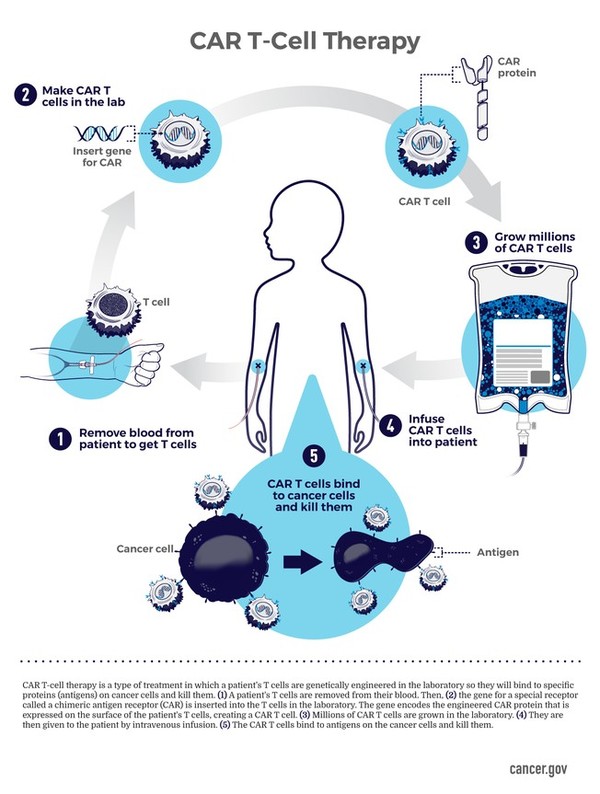
간단히 말해서, CAR T-세포 요법의 제조는 다음과 같이 작용한다. 먼저 환자 자신의 혈액을 채취하고 그 채취한 혈액에서 나온 백혈구를 분리하여 남은 적혈구와 혈장을 환자에게 돌려주는데, 백혈구 성분 채집술(분반술)라고 알려진 과정이다.
일단 채취한 백혈구가 확보되면, 연구 그룹들은 다른 백혈구로부터 특정 T세포를 분리하기 위해 다양한 방법을 사용한다. 그 후, 해롭지 않은 바이러스를 이용하여 T세포에 유전자 지시를 전달하여 자기 표면에 정착하게 되는 키메라 항원 수용체(CAR)와 세포 내부에 상주하는 공동 자극 분자를 생산하도록 한다.(T세포를 활성 상태로 유지하는 신호를 전달함으로써 공동 자극 분자는 CAR T세포가 생존할 수 있도록 도와주고 환자에게 다시 투여되면 성장한다.)
다음으로, 이 작은 양의 CAR T 세포는 수백만 개까지 증식하도록 유도된다. 이 과정은 T 세포의 적절한 "투여량"에 도달할 수 있을 만큼 충분히 성장하도록 세심하게 감시된다.
제조 과정의 마지막 단계에서는 CAR T세포의 순도와 품질을 보장하기 위한 몇 가지 중요한 보관과정이 필요하며, 이때 CAR T 세포는 환자에게 다시 주입될 준비가 된다.
CAR T-세포 치료에서는 환자가 백혈구 성분 채집술을 마친 후 그들의 T 세포는 수억 개의 유전자 변형 T 세포를 생성하는 복잡한 과정을 거서 정맥 주입을 통하여 환자의 몸에 다시 투여된다.
CD33 CAR T세포 실험의 공동 책임자이자 국립암연구소의 암 연구센터의 니랄리 샤 박사는 현재 소수의 연구실만이 CAR T세포의 제조 능력을 가지고 있다고 말했다.
"모든 연구실이 다 세포를 만들어 환자에게 줄 수는 없다." 라고 샤 박사가 말했다. 메릴랜드 주 베데스다의 국립보건원 임상센터에서 혈액 암 어린이들을 대상으로 여러 차례 CAR T세포 치료제 실험을 이끌어 온 샤 박사는 "이런 일을 잘 할 수 있으려면 기반시설과 지원, 지식이 있어야 한다.
웰치 박사는 생물학적 제품을 제조하기 위해 메릴랜드 주 프레드릭 시에 있는 프레데릭 국립암연구시험소(FNLCR)의 기존 시설인 바이오의약품 개발 프로그램(BDP)을 통해 국립암연구소가 CAR T-세포 연구를 가속화해야 하는 중요한 필요성을 충족시키는 데 도움을 줄 수 있는 기회가 있었다고 말했다.
그는 "생물약품개발프로그램(BDP)은 바이러스와 항체, 단백질, 백신 등을 제조해 초기 실험을 지원했던 경험이 있다. 그리고 BDP는 품질 제조 공정에 대한 경험을 가지고 있다."말했다. 그러나 이 프로그램에 결여된 부분은 CAR T 셀을 제조한 경험이 없었다는 것이다.
빠른 연구 작업에 중요한 협업
제조 노력을 뒷받침하겠다는 국립암연구소 지도부의 다짐과 함께, 다음 조치는 지원을 해야 할 첫 번째 시험을 찾아내고 제조 공정을 수립하는 것이었다.
국립암연구소에서 CAR T세포 치료법을 개발하고 시험하는 데 있어 국내 유수의 전문가들이 첫발을 내디뎠다. 국립암연구소 소아 종양학부(POB)의 샤 박사와 동료들은 이미 CD33 CAR T세포에서 작업하고 있었는데, 그들은 급성 골수성 백혈병 어린이들을 위한 실험을 향해 나아가고 있었다. 이 특정 CAR은 처음에 테리 프라이 박사에 의해 개발되었고, 그는 이전에는 POB의 소속이었으며, 지금은 콜로라도 의과대학 소속이다.
샤 박사는 "CD33 개념이 처음 개발되었을 때, 이전에는 복수 센터 시험을 계획할 수 있는 기반시설이 없었기 때문에 모두 단일 센터 1상 시험이 될 것으로 생각하고 있었다."고 말했다.
그러나 혈액 암을 앓고 있는 아이들을 위해 줄기세포 이식을 포함한 치료법을 개발하고 실험하는 데 주력하고 있는 샤와 아플렌크 박사와 같은 연구 커뮤니티는 매우 협력적이라고 말했다. 그리고 국립암연구소의 제조 계획이 온라인에 등장하면서, 그녀는 "이제는 다중 센터 시험에 대해 생각해 볼 수 있는 메커니즘이 생겼다"고 덧붙였다.
그 연구 커뮤니티에는 시험의 주요 후원자로 등장한 국제혈액 및 골수이식연구센터와 그 전반적인 활동을 관리할 국가 골수기증 프로그램(예: 세포의 운송을 감독하고 조정하며 환자 안전을 감시하는 것)이 포함된다.
다음으로 제조 공정을 확정할 때였다. 그 부지는 이미 확보되었다: 제조 공정은 박테리아와 단백질과 같은 생물학적 원천으로부터 약물과 치료법을 제조하는 생물의약품 개발 프로그램(BDP)이다.
국립암연구소 팀은 제조 전문성을 위해 국립보건원으로 눈을 돌렸다. 이들이 상담한 전문가로는 국립보건원 세포공학센터의 데이비드 스트론체크 박사와 스티브 하이필 박사 등이 포함돼 있어 NIH 내 연구자를 위한 CAR T세포 등 세포치료제 개발과 제조 경험이 풍부하다.
웰치 박사는 "그들의 전문성과 경험은 매우 귀중했다"고 말했다. 이러한 지침과 피드백으로 무장한 NCI 팀은 상대적으로 새로운 상용 시스템을 CAR T 세포 제조에 사용하기로 결정했다.
프로디지(Prodigy)라고 불리는 이 시스템은 "출입이 제한"되었는데, 이는 환자로부터 채취한 세포를 시스템에 넣으면 나머지를 처리해 2주 안에 완성되는 CAR T-세포 제품을 생산한다는 것을 의미한다고 국립암연구소 암 치료 및 진단부(DCTD)의 제이슨 요반디치 박사는 설명했다.
이때까지 대부분의 연구소와 FDA가 승인한 CAR T세포 치료제를 제조하는 회사들은 최종 제품을 생산하기 위해 더 많은 수동 조작이 필요한 '개방형' 시스템을 사용해 왔다. ‘출입 제한’ 시스템을 가진 요반디치 박사는 "중요한 변수는 들어 갈 환자 세포 뿐"이라고 말했다.
현재 국립암연구소는 ‘프로디지’ 시스템 2개를 보유하고 있으며, 3번째 공정을 추가할 계획이다. "이 계획이 어떻게 진행되느냐에 따라 더 많은 약물이 추가될 수 있을 것"이라고 그는 말했다.
다른 모델
CAR T-세포 치료제의 수많은 임상시험이 CHOP에서 실시되어 왔다. 아플렌크 박사는 예상외로 치료제가 시험 공정 내에서 제조되지 않고 있을 때 실험을 실시하는 차이점이 있다고 말했다. 그러나 다중 센터 시험에서는 단일 제조사(공정)가 이상적인 선택인 것 같다.
그는 "국립암연구소가 세포 제조를 하지 않았다면 다중 센터 시험을 하는 것이 매우 어려울 뻔 했다"고 말했다.
아플렌크 박사는 CD33 CAR T 세포를 한 곳에서 만드는 것에 대해 어떠한 문제도 예상하지 않는다고 말했다. 단일 센터의 연구소 내에서 CAR T-세포 치료제를 생산해도 항상 처리해야 할 물류가 있다. 예를 들어, 제조 시간은 "환자 볼륨과 제조 처리량에 의해 구동될 수 있는 그 센터의 현재 대기 물량에 의해 구동된다."고 그는 말했다.
그리고 CAR T-세포 치료법의 제조가 더욱 자동화되어 이러한 치료법과 관련된 연구에 관여하는 연구소의 수가 증가할 것으로 예상되지만, 중앙집중식 접근법은 새로운 치료법에 대한 인간의 임상 연구에 중요한 역할을 할 수 있다고 샤 박사는 지적했다. "이런 모델은 정말 많은 가능성을 가지고 있는 것 같다"고 그녀는 말했다.
웰치 박사는 제조 게획은 아직 초기 단계라며, 어떤 결과가 나오는지 보려면 시간이 걸릴 것이라고 강조했다. 그는 "우리는 여전히 걸음마를 하고 있다"고 말했다.
그렇더라도 여기까지 오려면 많은 작업과 협업이 필요했다. 그는 "이러한 것을 조립하려면 그렇게 해야 한다. 그 협업이 "우리가 이룬 진전에 엄청나게 중요하고 중요한 역할을 했다“고 말했다.
2020년 4월 23일 : 국립암연구소 제공
NCI Initiative Aims to Boost CAR T-Cell Therapy Clinical Trials
April 23, 2020, by NCI Staff
In 2010, an NCI research team published the first study of a new form of cancer treatment called CAR T-cell therapy, reporting on a single patient with advanced lymphoma whose disease, they recounted, “underwent a dramatic regression” following the treatment. The next year, researchers from the University of Pennsylvania reported a similar result using CAR T-cell therapy to treat a patient with an advanced form of leukemia.
Within 7 years, the Food and Drug Administration (FDA) approved the first two CAR T-cell therapies, and with a third approval expected sometime this year, research groups around the world are rapidly developing new CAR T-cell therapies.
These cancer treatments have captured public attention, and researchers’ imaginations, like few others. In part, that’s because of the remarkable way they can eliminate cancer in some people with advanced blood cancers. It’s also because of where they come from: a patient’s own blood. Components of that blood are then used to create the treatment.
Transforming those components into the therapy that is eventually returned to the patient requires a highly complex manufacturing process. And that’s part of what sets CAR T-cell therapy apart from most other cancer treatments, explained Anthony Welch, Ph.D., a project officer in NCI’s Division of Cancer Treatment and Diagnosis (DCTD).
“With CAR T cells, the process is the product,” Dr. Welch said. That process is also expensive, complicated, and highly regulated.
That’s part of what makes conducting human clinical trials testing these individualized CAR T-cell therapies more challenging than those involving “off-the-shelf” drugs that are manufactured in massive batches. Few laboratories and centers have the capability to make CAR T cells, which has limited the ability to test them more broadly.
To help address these challenges, more than a year ago, DCTD and NCI leaders turned to their experts at the Frederick National Lab for Cancer Research (FNLCR) and tasked them with developing the capability to produce cellular therapies like CAR T cells for cancer. Specifically, the goal was to accelerate the ability to test these therapies in clinical trials to be conducted at multiple hospital sites.
The initial clinical trial supported by this effort will be the first trial to test a CAR T-cell therapy designed to target a protein on cancer cells called CD33 in children and young adults with advanced forms of acute myeloid leukemia (AML). It will ultimately enroll patients at six different sites, starting at the NIH Clinical Center in Bethesda, MD, and the Children’s Hospital of Philadelphia (CHOP).
Having multiple sites for the first trial will be good for both the investigators and the patients, said the trial’s co-lead investigator, Richard Aplenc, M.D., of CHOP, where the first patient on the trial was enrolled in January.
“It will really expand access to this investigational therapy,” Dr. Aplenc continued. “We have sites on both coasts and in the middle of the country.”
And as researchers look to expand CAR T-cell therapy as an option for other cancers, including solid tumors, Dr. Welch said, lowering the barriers to their success will be critical.
“That’s the idea we’re trying to support,” he said. “We’re taking some of the risk out of [developing] innovative concepts and ideas by helping to bring more of these therapies into early clinical trials.”
From a Blood Collection to an Engineered Cell Therapy
In a nutshell, the manufacturing of a CAR T-cell therapy works like this.
First, a patient’s own blood is collected and the white blood cells from that collection are separated out, with the remaining red blood cells and plasma returned to the patient, a process known as leukapheresis.
Once the collected white blood cells are in hand, research groups use various methods to isolate specific T cells from the other white blood cells. Then, a disarmed virus is used to deliver genetic instructions to the T cells telling them to produce the chimeric antigen receptor (CAR), which ends up on their surfaces, and co-stimulatory molecules, which reside inside the cell. (By delivering signals that keep the T cells active, the co-stimulatory molecules help the CAR T cells to survive and grow once introduced back into the patient.)
Next, this small batch of CAR T cells is induced to multiply until they number in the millions, a process that is carefully monitored to ensure that they grow enough in number to achieve the appropriate “dose” of T cells.
The final step in the manufacturing journey requires some important housekeeping to ensure the purity and quality of the CAR T cells, at which point they are ready to be infused back into the patient.
In CAR T-cell therapy, after patients undergo leukapheresis, their T cells are subject to a complex process that produces hundreds of millions of genetically modified T cells that they then receive via intravenous infusion.
At the moment, only a small group of research labs have the ability to make CAR T cells, said Nirali Shah, M.D., of NCI’s Center for Cancer Research, the co-lead investigator on the CD33 CAR T-cell trial.
“You can’t just manufacture cells in any lab and give them to patients,” said Dr. Shah, who has led several trials of CAR T-cell therapies in children with blood cancers at the NIH Clinical Center in Bethesda, MD. “You need to have the infrastructure and the support and the knowledge to be able to do this well.”
With an existing facility, the Biopharmaceutical Development Program (BDP) at the FNLCR in Frederick, MD, for manufacturing biological products, Dr. Welch said, there was an opportunity for NCI to help meet a critical need to help accelerate CAR T-cell research.
“The BDP has experience manufacturing viruses, antibodies, proteins, and vaccines to support early trials,” he added. “It has experience with quality manufacturing processes.”
What the program didn’t have, however, was experience manufacturing CAR T cells.
Collaborations Critical to Quick Action
With a commitment from NCI leadership to back the manufacturing effort, the next steps were to identify the first trial to be supported and establish the manufacturing process.
Having some of the country’s leading experts in developing and testing CAR T-cell therapies at NCI helped with the first step. Dr. Shah and her colleagues in NCI’s Pediatric Oncology Branch (POB) were already working on a CD33 CAR T cell that they were moving toward a trial for children with AML. This specific CAR was initially developed by Terry Fry, M.D., formerly of the POB and now at the University of Colorado School of Medicine.
“When the CD33 concept was first developed, we were all thinking it would be a single-center phase 1 trial, because we previously did not have the infrastructure to plan for a multicenter trial,” Dr. Shah said.
But the community of researchers like Drs. Shah and Aplenc, whose work focuses on developing and testing treatments, including stem cell transplants, for children with blood cancers is highly collaborative, she said. And with the NCI manufacturing initiative coming online, she added, “there was now a mechanism to think about a multicenter trial.”
That research community includes the Center for International Blood and Marrow Transplant Research, which came on board as the trial’s primary sponsor, and the National Marrow Donor Program, which will manage its overall conduct (e.g., overseeing and coordinating the shipping of cells, monitoring patient safety).
Next, it was time to nail down the manufacturing process. The location had already been identified: the BDP, which manufactures drugs and therapies from biological sources, such as bacteria and proteins, for research studies.
The NCI team then turned to NIH for manufacturing expertise. The experts they consulted included David Stroncek, M.D., and Steve Highfill, Ph.D., of NIH’s Center for Cellular Engineering, which has extensive experience developing and manufacturing cell therapies, including CAR T cells, for investigators within NIH.
“Their expertise and experience was invaluable,” Dr. Welch said.
Armed with this guidance and feedback, the NCI team decided to use a relatively new, commercially available system for manufacturing CAR T cells.
The system, called Prodigy, is “closed,” meaning that once the collected cells from the patient are put into the system, it takes care of the rest, producing a completed CAR T-cell product within 2 weeks, explained Jason Yovandich, Ph.D., also of DCTD.
Up to this point, most laboratories and the companies that manufacture the two FDA-approved CAR T-cell therapies have used “open” systems, which require more manual manipulation to produce a final product. With a closed system, Dr. Yovandich said, “the only variable to account for is the patient cells going in.”
Currently, NCI has two Prodigy systems, with plans to add a third. Depending on how this initiative progresses, more could be added, he said.
A Different Model
Numerous clinical trials of CAR T-cell therapies have been conducted at CHOP. Dr. Aplenc said that, not unexpectedly, there are differences conducting a trial when the treatment is not being manufactured in house. But for a multicenter trial, a single manufacturer seems to be the ideal choice.
“If NCI was not doing the cell manufacturing, it would be extremely challenging to do this [multicenter trial],” he said.
Dr. Aplenc said he doesn’t expect any issues with having the CD33 CAR T cells made at a single location. Even when a CAR T-cell therapy is produced in house at a single institution, there are always logistics to deal with. For example, the manufacturing time “is driven by the current queue at that center, which can be driven by patient volume and manufacturing throughput,” he said.
And even as the manufacturing of CAR T-cell therapies becomes more automated, which is expected to increase the number of labs involved in research involving these therapies, a centralized approach can play an important role in human clinical studies of new treatments, Dr. Shah noted. “I think a model like this has so much promise,” she said.
Dr. Welch emphasized that it’s still early days for the manufacturing initiative and that it will take time to see how it plays out. “We’re still taking baby steps,” he said.
Even so, it’s taken a lot of work and collaboration to get this far. “That’s what it takes to put something like this together,” he said. The collaboration “has been tremendous and critical to the progress we have made.”
암스쿨에 게재된 기사는 미국국립암연구소(NCI), 미국암협회(ACS), 국립암센터(NCC), 일본국립암연구소(NCCJ), 엠디앤더슨암센터(MD Anderson Cancer Center) 등 검증된 기관의 검증된 자료를 토대로 작성되었습니다.
이 글은 2020년 8월 작성 시점의 정보입니다. 치료 기준·급여 정보는 바뀌었을 수 있으니, 진료와 치료 결정은 반드시 담당 의료진과 상의하세요.